You’re rolling up to a stoplight and there it is: a thin, high-pitched squeal every time you touch the pedal. Or maybe it isn’t a sound at all, but a faint shudder through the pedal or steering wheel as you slow down from highway speed. Either way, your brakes are trying to tell you something. The next question is usually simple: Do I need new brake pads, new rotors, or both?
When it comes to brake pads vs rotors, the answer depends on which part is worn and how long the warning signs have been going on. Here’s how to tell the difference, and why acting early usually saves money.
What Brake Pads Do
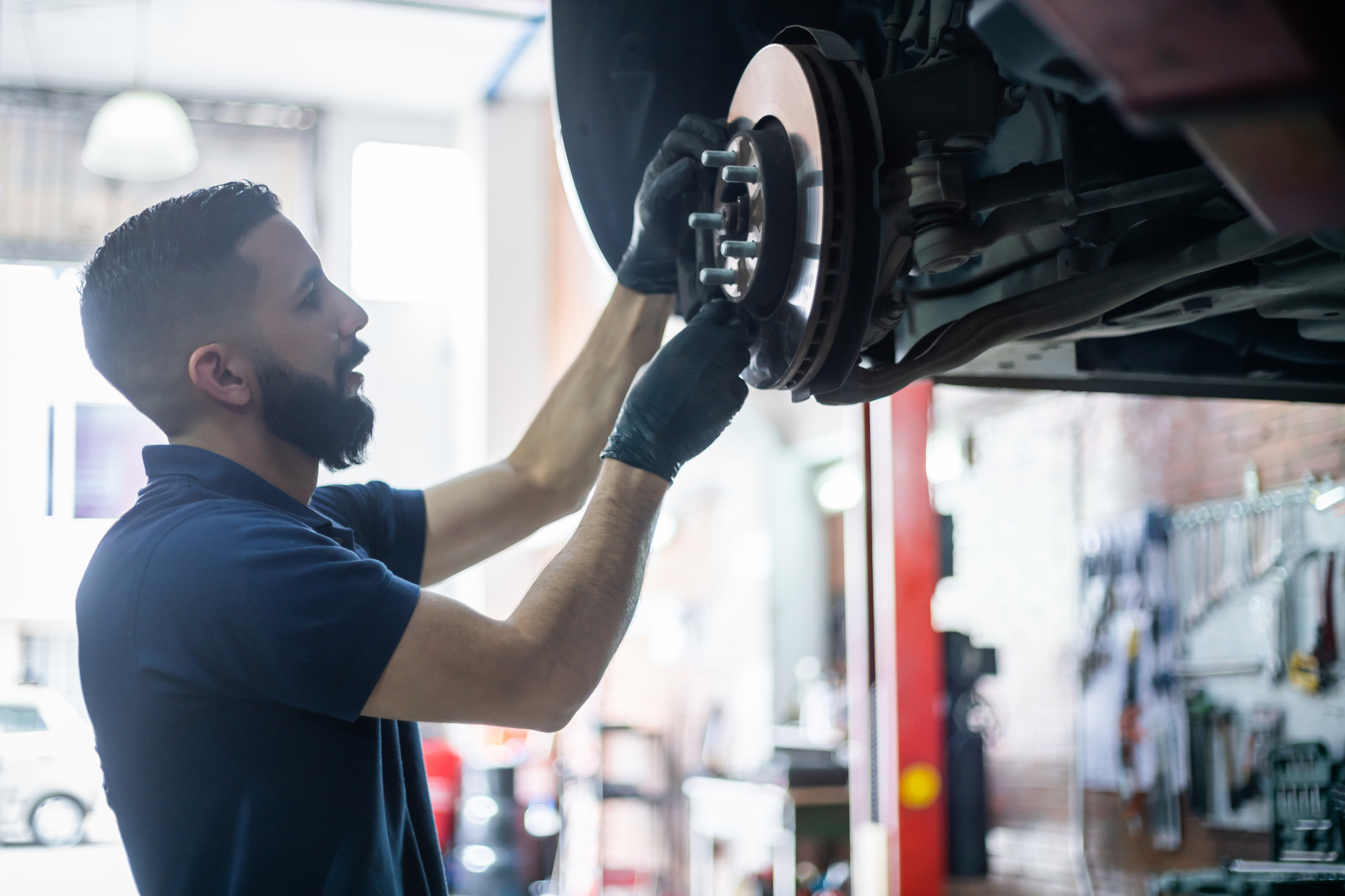
Most cars, trucks and SUVs today use disc brakes, at least on the front wheels. The brake pads sit in a caliper on either side of a spinning metal disc. When you press the pedal, hydraulic pressure squeezes the pads against that disc, and the friction slows you down.
Pads are meant to be the part that wears out. Every stop takes a little friction material with it, and most pads last somewhere between 25,000 and 65,000 miles, according to AAA. Where yours fall in that range depends on how hard you brake, how much stop-and-go driving you do, how heavy your vehicle is (and whether you tow), and what the pads are made of.
What Rotors Do
The rotor is the heavy metal disc the pads clamp onto. It spins with your wheel and absorbs the heat created every time you brake. Rotors are built to outlast pads, typically lasting 30,000 to 70,000 miles, and the rotors your vehicle came with are often designed to last through two or three sets of pads. Many make it that long. Just as many don’t.
When to Replace Brake Pads and Rotors: Which Part Is the Problem?
Because those mileage ranges are so wide, the warning signs tell you more than the odometer does. Here’s how they usually break down:
| What You Notice | Most Likely Culprit |
| Steady squeal when braking | Pads (wear indicator) |
| Grinding, metal-on-metal sound | Pads worn through; rotors may be damaged |
| Pulsing pedal or shaking steering wheel | Rotors |
| Grooves, a lip on the edge, or blue heat spots on the rotor | Rotors |
| Soft pedal, fluid leak or burning smell | Brake system issue; get it inspected right away |
That squeal comes from a small metal wear indicator built into many pads. It’s designed to make noise when very little pad is left, and it’s one of the classic signs it’s time for a brake repair. And the pulsing pedal often blamed on “warped” rotors? It’s usually caused by uneven rotor thickness or uneven pad deposits, not a bent disc. Either way, a technician has to measure the rotor to know the right fix.
Do I Need to Replace Rotors With Brake Pads?
Not always. If your rotors are smooth, within spec and undamaged, new pads alone may be enough. On a low-mileage vehicle’s first brake job, the rotors may not need any work at all.
Why Shops Often Recommend Brake Pad and Rotor Replacement Together
If your rotors are already close to their limit, replacing them along with the pads saves you a second trip and a second labor bill down the road. Here’s what usually tips the decision:
- Minimum thickness. Every rotor has a discard spec, usually stamped on the rotor itself. A rotor worn to that point, or one that would fall below spec after resurfacing, has to be replaced.
- Thinner rotors. Some original rotors are now made thinner to save weight, which leaves little metal to resurface.
- Cost. Some new rotors cost less than the labor to resurface the old ones.
- Damage from waiting. Keep driving on a squeal and it turns into a grind as the pad’s steel backing cuts into the rotor. That’s how a simple pad job becomes a pad-and-rotor job.
Resurfacing (also called machining or “turning”) is still a good repair when there’s enough metal left. One quick test: if you can feel the grooves with your fingernail, the rotor should probably be resurfaced or replaced.
What a Brake Inspection Includes
A good inspection goes beyond a glance through the wheel spokes. A technician should:
- Measure pad thickness (pads thinner than about 1/4 inch will likely need replacing)
- Measure the rotors for thickness and runout, not just look them over
- Check the calipers, slide pins and hardware so the pads release and wear evenly
- Check the brake fluid’s level and condition
If work is needed, pads should be replaced in axle pairs, both fronts or both rears, so braking stays balanced and the vehicle doesn’t pull to one side.
How often? AAA recommends having your brakes checked each time your wheels are rotated. Staying on that schedule is one of the must-know facts about brake safety every driver should keep in mind.
Common Questions
Should I replace brake pads on just one wheel?
No. Pads should be replaced in axle sets, meaning both front wheels or both rear wheels together. That keeps braking even, so the vehicle doesn’t pull to one side.
Can rotors be resurfaced instead of replaced?
Sometimes. Resurfacing can restore a smooth surface if the rotor will still be above the manufacturer’s minimum thickness afterward and has no cracks or heat damage. Thin, damaged or heat-spotted rotors should be replaced.
Next Step: Book a Brake Inspection in Aurora
Squealing, grinding, a pulsing or soft pedal, a burning smell or a fluid leak are all signs it’s time for a brake inspection. And with winter on the way, now is a good time to make sure your brakes are ready. And with winter on the way, now is a good time to make sure your brakes are ready for braking in cold weather.
At Chase Automotive Repair, our ASE-certified technicians can inspect your pads, rotors and the rest of your brake system, then explain what they find. We’re a family-owned shop at 15601 E. 6th Ave. in Aurora, serving Aurora and the Denver metro area, and we’ve been taking care of local drivers since 1990.
Right now you can save $100 on brake pad and rotor replacement with the coupon on our specials page (most vehicles, expires 11/30/2026).
Ready to find out which one you need? Visit our brake repair page for Aurora drivers to schedule your brake inspection, or call (303) 344-4670.